Avoid paint damage: how to keep your Volvo like new
Paint damage happens in seconds. A car door opened carelessly in a multi-storey car park, a stone chip on the A4, a shopping trolley that rolls away. The paintwork on your Volvo is more than a pretty coat: it is the first layer of protection against moisture, road salt and UV radiation. Once that layer is broken, the clock starts ticking underneath.
This guide explains how paint damage happens and how you can avoid it.
How does paint damage happen?
Paint damage is caused by mechanical, chemical or weather-related influences. These five causes are the most common in Switzerland:
- Grit and road salt: After winter, plenty of grit is left on mountain roads and driveways. It causes stone chips on the front end, bonnet and sills, and salt then works its way into them. Damage that looks harmless in November can be rusting by March.
- Car park knocks: Car doors, handlebars, shopping trolleys. Most scratches happen in tight car parks, and whoever caused them is usually long gone.
- Hail and sun: Summer storms often hit the bonnet and roof across a wide area and leave dents behind. Constant UV radiation fades red and black paintwork.
- Bird droppings, tree resin, insect remains: All three contain acids. Left in place, they etch into the clear coat and leave matt patches.
- Incorrect care: Wiping dry surfaces and using hard brushes creates fine scratch marks that show up in low, angled light.
Why should you avoid paint damage?
How serious paint damage turns out to be depends on which layer of paint has been affected. Superficial damage is barely visible because it often only touches the clear coat. Deeper damage belongs in the hands of specialists.
Do not lose time. Deal with this kind of damage early, before it is too late. Once several layers are damaged, the metal underneath is exposed and becomes vulnerable to rust. That can weaken the structure of your car and reduce its resale value.
The fingernail test
Run your fingernail across the scratch. If the nail glides over it, the damage is limited to the clear coat. Scratches like these can usually be polished out quickly.
If your nail catches, the scratch sits deeper and has reached the base coat or the primer.
How quickly does paint damage rust?
As soon as bare metal is exposed, oxidation begins. Add moisture, and road salt in winter, and surface rust often shows up within a few weeks. After that, the rust works its way sideways underneath the intact paintwork, where you cannot see it.
Deep paint damage is therefore not just a cosmetic problem. Rust weakens the metal, and visible rust noticeably pushes down the resale value of your Volvo. Acting early costs less in the end.
How to avoid paint damage
To stop the problem arising in the first place, protect your car’s paintwork. Here are six tips on how best to look after your Volvo:
Choose your parking space deliberately
Most paint damage happens while the car is stationary. If you have a garage or a space in an underground car park, use it. That rules out car park knocks, bird droppings and hail in one go.
Outdoors, the spot makes the difference. Keep your distance from neighbouring vehicles so that nothing catches when doors open. Spaces at the end of a row or against a wall only have one exposed side.
These spots cost you more paintwork than the walk saves you:
- under trees, because of resin and bird droppings
- next to shopping trolley bays
- in front of passageways, entrances and stairwells, where people pass by with bags and bicycles
Against deliberate scratches, from a key for example, visibility helps most. A well-lit, busy space is targeted less often than a dark corner.
Paint protection film on exposed areas
A transparent paint protection film absorbs stone chips before they reach the paintwork. Against mechanical damage it is the most effective measure available.
Wrapping the whole car does cost a lot, though. Partial coverage is often enough, applied where damage actually occurs: front bumper, bonnet edge, wing mirrors, sills and loading edge. Fitting belongs in professional hands, otherwise you end up with bubbles and visible edges.
Clean regularly and thoroughly
Road salt, acids and road grime attack the paintwork for as long as they sit on it. How often you wash therefore has a direct effect on how long the paintwork lasts.
In winter, a shorter interval pays off. A wash every two weeks, underbody included, removes the salt before it works its way into seams and wheel arches. That is exactly where rust starts, and where you will not see it from the outside for a long time.
Bird droppings, tree resin and insect remains cannot wait. Once they dry on, their acids etch into the clear coat. Remove them straight away.
Drivers in Switzerland spend around CHF 300.– a year on cleaning their vehicles, according to a study by the TCS. What matters, though, is not only how often you wash but how. You will find the details in our article on car body care. For a car wash, simply drop by our car wash in Baar.
Paint wax
A layer of wax seals the top coat and acts as protection for the paintwork. It is an inexpensive option that you can easily apply yourself and that offers a certain amount of protection. Do not expect it to prevent chips or paint damage completely and permanently. An alternative is a paint sealant, although this needs some time to dry fully.
Car cover
If your Volvo stands outside for weeks at a time, a breathable cover helps against bird droppings, resin and sun. There is one condition: the paintwork must be clean before you fit it. Sand trapped under the cover does more damage than the weather.
Polishing
Polish the paintwork regularly to protect it. Alongside a smart shine, your Volvo gains a protective layer against outside influences. To make sure the polish is applied properly and evenly, leave it to the professionals in a workshop.
What does paint damage cost to repair?
There are no flat rates. The work is determined above all by how deep the damage goes and where it sits. Polishing out a clear coat scratch is a matter of minutes; rebuilding metal takes days. A single spot in the middle of a wing is straightforward. If the scratch runs across an edge or across two panels, blending into the surrounding paint is added to the job.
Then there is the colour. Solid colours are simple, while metallic and pearlescent finishes call for precise mixing and more layers. The biggest difference, however, comes from the method. Smart repair treats only the damaged spot and costs considerably less than respraying the entire panel.
Always have the damage looked at by a garage first. Photos are often enough for an initial assessment.
Does insurance cover paint damage?
That depends on who caused it. If the person is known, their third-party liability insurance pays. If you touched a pillar yourself while manoeuvring, fully comprehensive cover applies.
Deliberate damage is clearly covered. Partial comprehensive insurance covers vandalism, smashed mirrors for example. Scratching and spraying, however, are frequently excluded in the policy conditions.
With car park damage caused by an unknown party, it comes down to your policy. Some fully comprehensive policies cover scratches like these, usually with an excess and a loss of no-claims bonus. Individual insurers offer separate additional cover for this, AXA among them.
If no insurance applies, the National Guarantee Fund remains. It provides subsidiary cover for damage caused by unidentified or uninsured motor vehicles and cyclists, with an excess of CHF 1’000.– per injured party.
With any car park damage, note down the time and place and photograph the damaged area.
Repairing minor paint damage yourself
With individual stone chips you can take matters into your own hands. You will find the colour code for your Volvo on the type plate. Clean and degrease the area first. Then apply the touch-up pen in thin layers and let each layer dry completely. Patience gets you further here than materials.
If rust has already formed, it has to come off completely. Leave any of it behind and it carries on working undisturbed beneath the new paint.
When to take the car to a workshop instead
Leave these cases to a specialist workshop:
- scratches longer than a few centimetres
- metallic and pearlescent finishes
- damage on edges, swage lines and curves
- areas larger than the palm of your hand
- rust that has already worked its way under the paintwork
The reason is awkwardly simple: a botched repair stands out more in the end than the original damage did. Colour deviations and hard edges can only be corrected later with considerable effort.
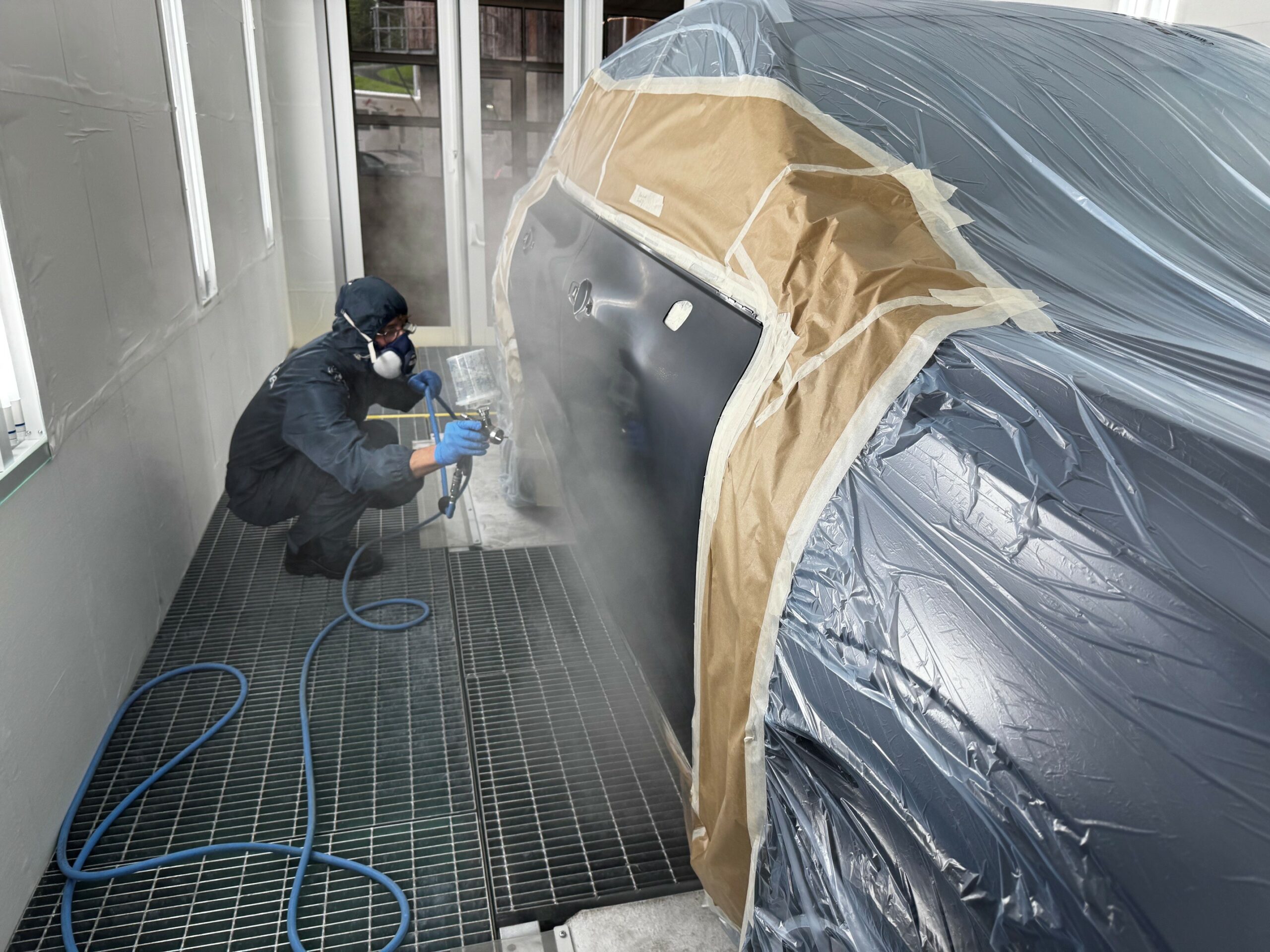
Bodywork and paint repairs coming in-house at our new Neuheim site
Until now, Hüsser & Palkoska has outsourced bodywork and paint repairs to partner businesses. That is changing. A dedicated bodywork and paint department is being set up at our new site in Neuheim.
In future, assessment, repair and painting will all run in-house. That means shorter routes, direct discussions and quality control from start to finish. Your Volvo stays in our hands from diagnosis through to polishing.
The Neuheim site is still being set up. We will announce the opening date shortly.
Your contact for paintwork and bodywork in the canton of Zug
Paint damage can often be prevented with a few habits. If something does happen, how quickly you react decides how much work it takes.
Hüsser & Palkoska has been looking after Volvo drivers in Baar since 1969. We assess the damage, recommend the right method and carry it out properly.
Book an appointment now and have your paint damage repaired professionally.
This article was published on 12 March 2025 and updated on 11 August 2026.